My Assess and Reflect System to Ensure Student Understanding
Most classrooms rely on assessments to measure learning but not necessarily improve it. I used to do a one question exit ticket that quickly assessed my students’ understanding. It was usually an intermediate level question that I gave to all students. There was no depth of knowledge, writing, or self-assessment in my exit tickets. Students also never received feedback and allowed time to reflect. They needed the chance to process, correct, and learn from their mistakes in real time.
I now do exit tickets differently. Here is how I incoporate it into my class routine. I always start class with a warm-up that not only allows students to practice end-of-year assessment questions in the REVIEW section, but it also helps introduces the lesson with the FLUENCY section (see my blog post for more information on my warm-up routine). I then flow into the lesson. I model the example problems and then have students summarize the lesson in sentences.
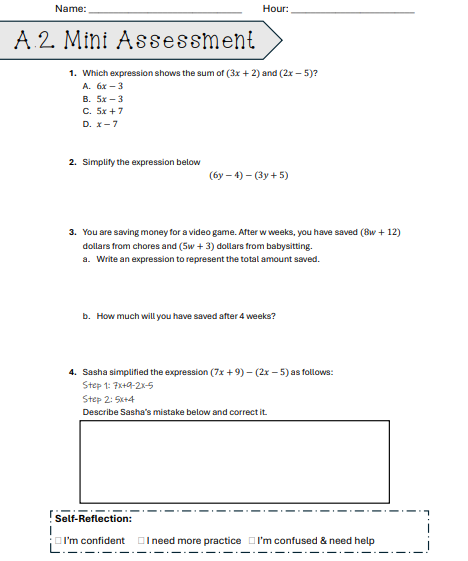
Right after our summary, I pass out the “Mini-Assessment”. Students are given about 5-10 minutes to complete the assessment. Students are also expected to check their confidence level with the lesson using the self-reflection checklist at the bottom. When students are finished, they turn the mini-assessment into me for quick grading. I assess students using the following scale: Advanced , Mastery, Basic, Approaching Basic, and Unsatisfactory
For example, the mini-assesment shown is worth 6 points (one point for each answer the students need to provide). They are graded as follows:
6/6 points = Advanced
5/6 points = Mastery
4/6 points = Basic
3/6 points = Approaching Basic
2/6 points or less = Unsatisfactory
This grading is super quick! I grade the assessments as students turn them in. Early finishers work on homework until the others are finished.
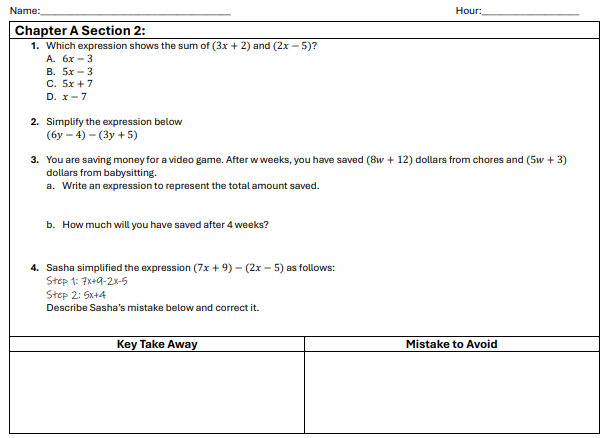
Now this is where the magic happens. I hand the mini-assessments back out with their scores, and students fill out the anchor chart printed on the back of the mini-assessment. The anchor chart re-asks the questions, and students fill out the anchor chart as a sort of "answer key” to the mini-assessment. I usually have students come to the board to work the problems for the class. As a reflection after the review, students also explain the key take away from the lesson and a mistake to avoid in the future. Students love to participate in sharing their key take aways and mistake to avoid!
I have students keep these assessments in their math binders and BOOM - there is a study guide already made for the test! They are AMAZING, and I have seen such a difference in student understanding after implementing this system!
The whole process takes about 15 minutes. Since I teach gifted students, I am able to fit about 5-6 questions on my mini-assessments. This could be trimmed down to 3-4 questions for the regular education classroom if needed. The warm-up is about a 5-10 minute process. This leaves us 20 minutes for teaching the content. It’s the perfect amount of time to round out a 45 minute class! Let me know your thoughts!
