The 10-Minute Daily Warm-Up Routine
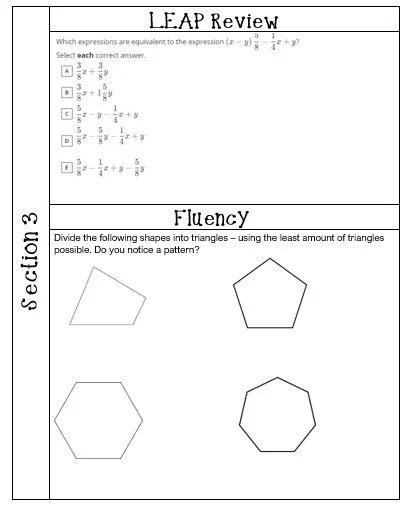
This routine is how my students walk in, get focused immediately, and stay in end-of-year assessment mode - without it taking over the whole class period or prepping for three full weeks before the test. It’s consistent, fast, and it sets up the day’s lesson.
The Goal
In under 10 minutes, student will:
Practice end-of-year style question every day (so test format questions feel normal).
Build fluency with prerequisite skills needed for today’s lesson.
Start class with structure: enter, sit, work… with no time wasted.
The Routine, Format & Timing
I have the warm-up displayed on the Promethean board, and students also have a copy of the warm-up in their binders.
I print warm-ups a chapter at a time. One warm-up per section (or maybe two or more warm-ups per section if the section takes us multiple days to get through).
The warm-up format:
LEAP Review: This is always modeled after the end-of- year assessment. In Louisiana, the end-of-year assessment is broken into two types of questions: Type 1 and Constructed Responses (open ended questions). I typically pull Type 1 questions for my warmups:
Multiple Choice
Multiple Select
Drag-and Drop (I make them draw arrows)
Short Response
This keeps students in low-stress, daily exposure to test language and question structures, so nothing feels “new” the day of the test. Look for released end-of-year assessment questions to start building your own warm-ups! Or pull from practice tests released by your state. Many tests are available online.
FLUENCY: The fluency problem is the bridge between what they should now and where it’s going. It should serve two purposes: 1) Review of previously learned material and 2) Allow for an opening of where the lesson is going.
In the image above, my students already learned the interior angles of a triangle add to 180 degrees. By having them create triangles inside polygons, I can easily get students to notice the pattern that the least number of triangles created inside the polygon is always two less than the number of sides. From there, I can pose the question: “What is the sum of the interior angles of this polygon?” There will be at least one student that multiples the number of triangles created inside the polygon by 180, which allows me to introduce the interior angle formula: S= (n-2)x180.
If you are provided a curriculum by your district, many of them come with pre-requisite questions. These are great resources for building the fluency part of your warm-ups.
I allow students the first couple of minutes to work through the problems. While they work indepently, I circulate and take mental notes on who’s sturggling, who has it, and common mistakes. Once all students are nearly finished (approximately 3-5 minutes), I begin calling students to the board to show work and explain.
As students are working the problem, this is great time to practice your questioning skills! Here are some tips:
Ask strategy comparison:
Did someone get the same answer using a different method?
Which method do you believe is more efficient and why?
Use error analysis (politely):
Do you agree or disagree? Defend your answer.
Ask for reasoning, not just answers:
Convince me.
Why did you do that step?
What tells you this is a logical answer?
The review part of the warm-up should round out the 10 minutes. This routine works because it does so much in such little time. Give it a try, and let me know if it makes a difference for you and your students!
